Outdoor games provide an enjoyable way to bring people together while encouraging physical activity, coordination, and friendly competition. Many traditional games remain popular because they are easy to organize, require relatively little equipment, and can be enjoyed by different age groups. Mölkky is one such activity, combining simple throwing skills with number recognition and strategic decision-making.
The Molkki Game is a Finnish outdoor throwing game played with wooden pins and a throwing baton. Players take turns aiming at numbered pins, attempting to reach an agreed target score while following specific scoring rules. Its combination of accuracy, planning, and unpredictable results makes it suitable for gardens, parks, family gatherings, school activities, and casual competitions.
What Is the Molkki Game?
Mölkky is a Finnish throwing game in which players use a wooden baton to knock over numbered wooden pins. The objective is to reach exactly 50 points before the other players, although the precise rules should always be agreed upon before starting.
Unlike games that depend entirely on strength or speed, Mölkky rewards accurate throwing and careful score management. Players must decide which pins to target based on their position, number, and the current score.
The game is often played outdoors on a relatively flat surface, such as grass, sand, or a suitable recreational area. It can be enjoyed individually in a group competition or as a team activity.
Equipment Needed to Play Mölkky
A standard Mölkky set includes a throwing baton and a group of numbered wooden pins. Some sets also come with a carrying case or storage container.
1. Numbered Wooden Pins
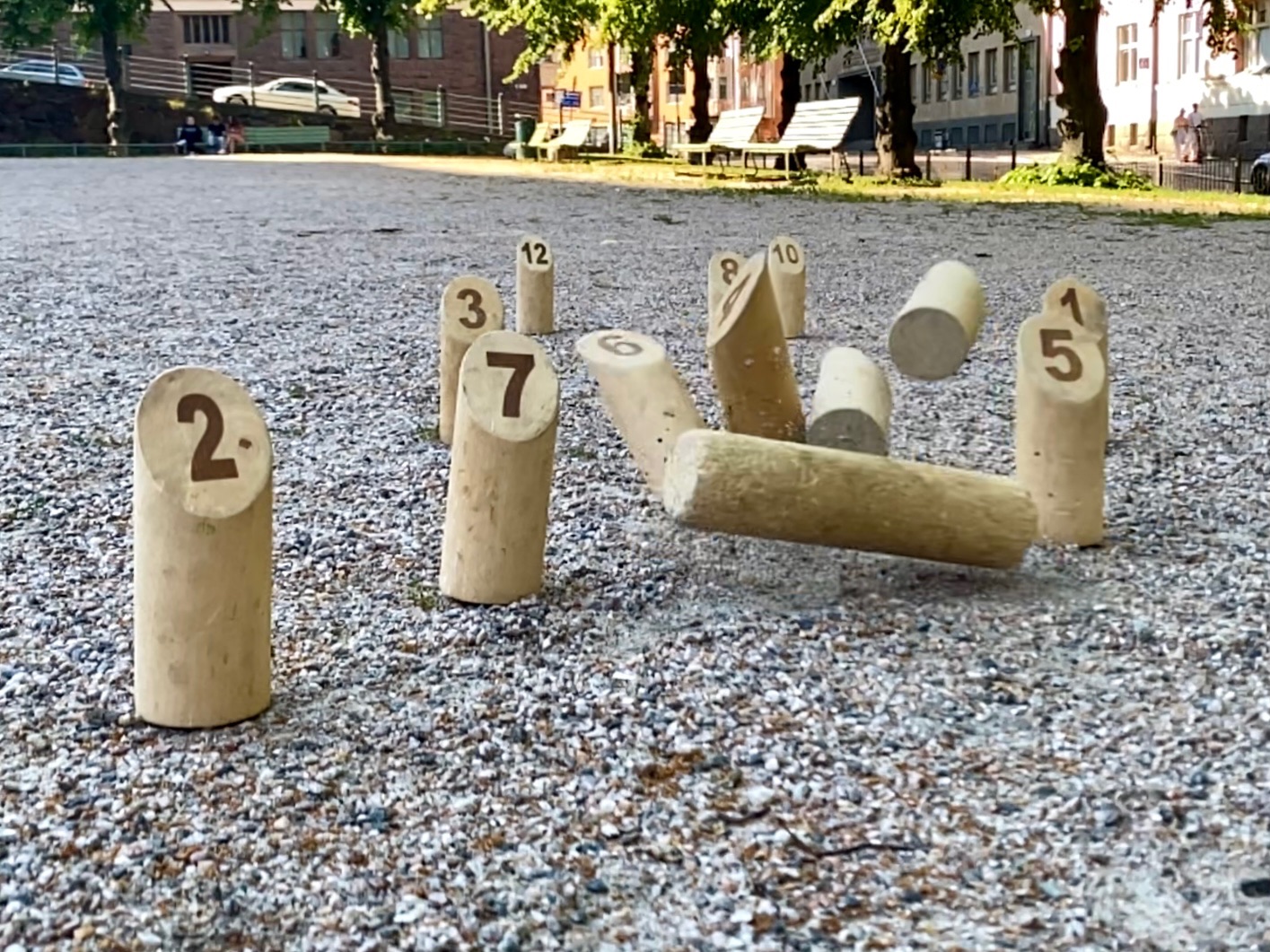
The pins are the main targets of the game. A traditional set contains 12 pins, each marked with a number from 1 to 12.
These pins are initially arranged in a specific formation. After being knocked over, they are stood upright at the locations where they land. This gradually spreads the targets across the playing area and changes the difficulty of later throws.
2. Throwing Baton
The throwing baton, also called the Mölkky, is a short wooden cylinder used to knock down the pins.
Players should hold it comfortably and throw it using a controlled underhand motion. Its shape and weight allow it to roll or strike the pins during play.
3. Playing Surface
A suitable outdoor surface is important for consistent gameplay. Grass, compacted sand, and other reasonably level areas are commonly used.
The surface should provide enough space for the pins to spread out and for players to throw safely from the designated line.
4. Score Sheet or Scoreboard
Keeping track of points is essential because the winner must reach the target score exactly. A score sheet, notebook, or simple scoreboard can help players avoid mistakes.
5. Storage Bag or Carrying Case
A storage bag makes it easier to transport the wooden pieces and keep the complete set together. It is especially useful for people who regularly take the game to parks, beaches, or family gatherings.
How to Set Up the Molkky Game
Correct setup helps ensure that everyone understands the playing area and can participate safely.
Step 1: Choose a Suitable Location
Find a flat outdoor space with enough room for throwing and retrieving the pins. Remove obstacles that could interfere with play or create a safety risk.
Step 2: Arrange the Numbered Pins
Place all 12 pins upright in the traditional starting formation. The pins should be positioned close together according to the standard arrangement.
The numbers should face outward where possible so that players can identify their targets.
Step 3: Mark the Throwing Line
Choose a throwing position a suitable distance from the pins. Traditional Mölkky rules commonly use a throwing distance of approximately 3 to 4 metres, depending on the setup and applicable rules.
Players should throw from behind the line without stepping over it.
Step 4: Decide the Playing Order
Players can determine the starting order through a random draw or another agreed method. Once the order is established, everyone takes turns throwing the baton.
Molkky Game Rules Explained
The rules are straightforward, but understanding the scoring system is important for a fair game.
Rule 1: Take Turns Throwing
Each player throws the baton once during their turn, aiming to knock down one or more numbered pins.
The throw should be made using the agreed throwing technique, typically an underhand motion.
Rule 2: Understand How Points Are Awarded
The score depends on how many pins fall and how they land.
- If exactly one pin falls, the player earns the number printed on that pin.
- If two or more pins fall, the player earns one point for each fallen pin, regardless of their individual numbers.
- If no pins fall, the player receives zero points.
For example, knocking down only the pin numbered 8 earns eight points. Knocking down three pins earns three points, even if their numbers add up to a higher total.
Rule 3: Reset Fallen Pins
After each throw, all fallen pins are stood upright at the exact locations where they came to rest.
This is an important feature of Mölkky because the playing arrangement gradually changes. Pins become more spread out, creating different throwing challenges.
Rule 4: Reach Exactly 50 Points
The usual objective is to become the first player to reach exactly 50 points.
If a player exceeds 50 points, their score is commonly reduced to 25. This rule encourages players to consider their current score before choosing a target.
Rule 5: Avoid Repeated Misses
In traditional rules, a player who misses all pins three consecutive times is eliminated from the game.
This rule encourages participants to remain focused and make deliberate throwing decisions.
Understanding the Molkky Scoring System
The scoring system makes Mölkky different from many other throwing games. Players must think about both accuracy and the number of pins they can knock down.
Consider the following examples:
| Throw result | Points earned |
|---|---|
| Only pin number 5 falls | 5 |
| Only pin number 11 falls | 11 |
| Two pins fall | 2 |
| Four pins fall | 4 |
| No pins fall | 0 |
The distinction between knocking down one pin and several pins is important. Hitting a high-numbered pin individually can produce more points than knocking down several pins together.
Example of a Score Sequence
Imagine a player starts with zero points and makes these throws:
- First throw: knocks down pin number 7 and earns 7 points.
- Second throw: knocks down two pins and earns 2 points.
- Third throw: knocks down pin number 10 and earns 10 points.
The player’s total is now 19 points.
As the game progresses, the player must consider which available target will help reach 50 without exceeding it.
Benefits of Playing the Molkky Game
Mölkky offers more than outdoor entertainment. It encourages a combination of physical, mental, and social skills.
1. Develops Hand-Eye Coordination
Players must judge the position of the pins and direct the throwing baton accurately. This repeated activity encourages coordination between visual observation and physical movement.
2. Encourages Strategic Thinking
The scoring system requires players to consider their current total and choose suitable targets. A high-numbered pin may be attractive when a player needs many points, while a lower-value target may be more appropriate near the end of the game.
3. Supports Basic Mathematics
Players regularly add scores, compare totals, and calculate how many points remain before reaching 50. This makes the game a practical way to introduce arithmetic through recreation.
4. Promotes Outdoor Activity
Playing Mölkky encourages participants to spend time outside, walk between turns, retrieve pins, and remain physically active.
5. Builds Patience and Concentration
Accurate throwing requires attention to distance, target position, and technique. Players benefit from taking their time rather than rushing each attempt.
6. Encourages Social Interaction
Mölkky can bring family members, friends, classmates, and colleagues together. Taking turns and following shared rules creates opportunities for communication and friendly competition.
7. Offers Inclusive Recreation
The game does not require advanced athletic ability. Beginners can learn the basics quickly, while experienced players can develop more precise throwing techniques and scoring strategies.
Tips for Improving Your Mölkky Throwing Technique
Improving performance involves practicing accuracy and learning how the pins respond to different throws.
Focus on a Controlled Throw
A smooth underhand motion is generally more useful than throwing with excessive force. A controlled release helps players direct the baton toward the intended target.
Study the Pin Arrangement
Before throwing, examine the position of the pins. Look for individual targets that can be reached without accidentally knocking down several pieces.
Adjust Your Throwing Strength
Different distances and pin arrangements may require different amounts of force. Practice helps players understand how much power is needed for reliable results.
Consider Your Current Score
A player who needs only a few points should avoid knocking down multiple pins if doing so could produce an unwanted total. Planning ahead is an important part of the game.
Practice Consistently
Regular practice helps players become familiar with the baton, throwing distance, and movement of the pins. Short practice sessions can improve confidence and consistency.
Common Mölkky Strategies for Better Gameplay
Mölkky involves several decisions beyond simply aiming at the nearest pin.
Target individual high-value pins when appropriate. Knocking down one high-numbered pin can provide more points than hitting several pins together.
Use multi-pin throws strategically. If only a few points are needed, knocking down a specific number of pins may be a safer option than targeting a high-value piece.
Pay attention to pin positions. As the game progresses, some targets may become easier or harder to reach. Choose throws based on the current arrangement.
Avoid exceeding the target score. When approaching 50 points, calculate the value of possible throws before making a move.
Observe other players. Watching how the pins move after each throw can help you understand which targets are likely to remain accessible.
Where Can You Play Mölkky?
One advantage of Mölkky is that it can be played in a variety of outdoor settings, provided there is enough space and a suitable surface.
Gardens and Backyards
A garden or backyard can provide a convenient location for casual games. Families can set up a small playing area and enjoy several rounds without needing to travel.
Parks
Public parks often provide open spaces suitable for group activities. Players should check local rules and choose an area where the game will not interfere with other visitors.
Beaches
Some beaches offer suitable compact sand areas for recreational throwing games. Players should select a stable surface and avoid areas with heavy foot traffic.
School Playgrounds
Mölkky can be used during supervised recreational sessions. Teachers and activity coordinators can organize small groups and introduce scorekeeping exercises.
Campsites and Outdoor Events
The game is portable and can provide entertainment during camping trips, picnics, community events, and outdoor celebrations.
How to Choose a Quality Molkky Game Set
The quality of the wooden pieces can influence both gameplay and product lifespan. Buyers should consider several factors before selecting a set.
Wood Quality
Look for solid, properly finished wooden components. The pins and throwing baton should feel sturdy enough for repeated use.
Consistent Dimensions
The pins should have reasonably consistent dimensions and a suitable shape. The throwing baton should also be comfortable to hold and use.
Clear Number Markings
Numbers should be easy to read and applied in a durable way. Clear markings make it easier to identify targets and calculate scores.
Smooth Finishing
Check that the wooden pieces have smooth surfaces and no noticeable splinters or sharp edges. This is especially important when children will be playing.
Complete Equipment
Confirm that the set includes the expected 12 numbered pins and one throwing baton. A carrying bag and instructions can also be useful additions.
Suitable Storage
A durable storage bag or container protects the pieces during transport and helps prevent components from becoming lost.
Caring for Your Wooden Mölkky Set
Wooden outdoor equipment can last longer when it is stored and maintained correctly.
- Clean the pins and baton after use, especially if they have been played with on sand or damp ground.
- Allow wet pieces to dry completely before storing them.
- Keep the set in a dry, ventilated location.
- Avoid leaving wooden components exposed to rain for extended periods.
- Store all pieces together in a suitable bag or container.
- Check the wood regularly for cracks, splinters, or other damage.
- Follow any care instructions supplied by the manufacturer.
Regular inspection is particularly useful for sets used frequently by schools, clubs, or activity organizers.
Mölkky Compared With Other Outdoor Throwing Games
Mölkky is part of a wider category of outdoor games that involve throwing objects toward targets. However, its numbered pins and distinctive scoring system give it a different playing experience.
| Feature | Mölkky | Traditional target-throwing games |
|---|---|---|
| Main equipment | Numbered wooden pins and baton | Varies by game |
| Main objective | Reach the target score exactly | Hit targets or achieve a defined score |
| Scoring | Individual pin values or one point per pin knocked down | Depends on the rules |
| Strategy | Combines accuracy and score management | Varies by activity |
| Playing environment | Usually outdoors | Indoor or outdoor, depending on the game |
| Group suitability | Suitable for individuals and teams | Depends on the format |
For people who enjoy games that combine physical skill with simple mathematics, Mölkky offers a distinctive alternative to conventional throwing activities.
Organizing a Friendly Mölkky Competition
A small competition can make the game more engaging for families, schools, and community groups.
Start by choosing a suitable playing area and preparing the pins. Divide participants into individuals or teams, then agree on the scoring rules and throwing order.
Keep a visible scoreboard so everyone can follow the progress. If several rounds are planned, organizers can record the results and award recognition to the highest-scoring participants.
For younger players or beginners, it may be helpful to explain the rules with a practice round before the competition begins. Adults should also ensure that players stand behind the throwing line and that nobody enters the target area while a throw is taking place.
Conclusion
The Molkky Game is a traditional outdoor activity that combines throwing accuracy, strategic thinking, basic mathematics, and social interaction. Its straightforward equipment and easy-to-learn rules make it suitable for family gatherings, school recreation, parks, and outdoor events.
A quality set should include durable wooden pins, clear number markings, a comfortable throwing baton, and practical storage. By learning the scoring system, practicing controlled throws, and planning each move carefully, players can enjoy a more rewarding experience.
Whether played casually with family or organized as a friendly competition, Mölkky offers an entertaining way to spend time outdoors while developing useful skills.