Consistent thermal processing is essential for commercial food manufacturers that produce shelf-stable packaged products. Achieving reliable sterilization requires more than reaching a target temperature inside a processing chamber. Heat must be distributed effectively throughout the product load, and each container must receive the thermal treatment established for its specific food and packaging format. Temperature variations, unsuitable loading arrangements, and inadequate process controls can all affect sterilization performance.
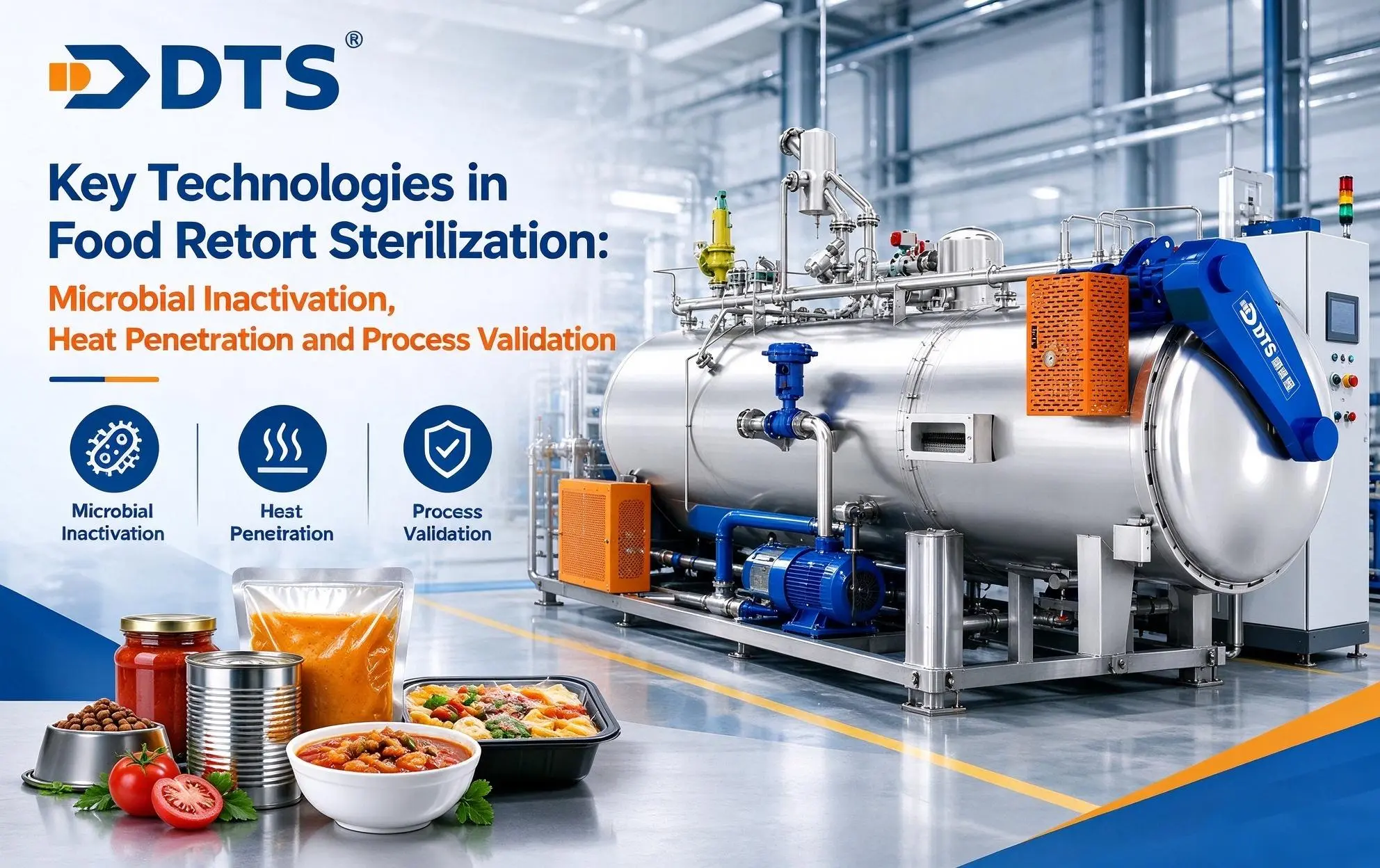
A Food Sterilization Retort provides controlled heating and pressure conditions for processing sealed food containers. Its ability to support reliable production depends on chamber design, heating medium, circulation performance, temperature monitoring, and carefully established operating procedures. Understanding temperature distribution and process validation helps manufacturers evaluate retort performance and maintain consistent thermal processing operations.
Understanding Food Sterilization Retorts
A food sterilization retort is an industrial pressure vessel used to process packaged foods at controlled temperatures for specified periods. The equipment transfers thermal energy to sealed containers to reduce microorganisms that could compromise product safety or shelf stability.
Retort systems are commonly used for:
- Canned vegetables and fruits
- Meat and poultry products
- Seafood and fish
- Soups and sauces
- Ready-to-eat meals
- Retort pouch products
- Other compatible shelf-stable packaged foods
Different retort designs use different heating methods, including saturated steam, water spray, water immersion, and cascade water distribution. The appropriate system depends on product characteristics, packaging requirements, production capacity, and the scheduled thermal process.
Why Temperature Distribution Matters
Temperature distribution describes how evenly heat is distributed throughout the retort chamber during processing.
Although the control system may display the required processing temperature, conditions can vary at different locations inside the vessel. These variations may result from chamber geometry, heating medium circulation, nozzle positioning, air removal, loading arrangements, or equipment performance.
Uneven temperature distribution can create challenges because some containers may experience different thermal conditions from others.
Effective temperature distribution helps manufacturers:
- Identify potential cold areas inside the chamber
- Evaluate the performance of the heating system
- Confirm suitable loading arrangements
- Support repeatable processing conditions
- Establish reliable operating procedures
- Reduce avoidable temperature variations
Temperature distribution must be evaluated under defined conditions rather than assumed from the control panel reading alone.
Factors That Influence Temperature Distribution
Several equipment and operating characteristics determine how heat moves throughout a retort.
1. Chamber Design and Dimensions
The internal geometry of the pressure vessel influences the movement of steam or heated water.
Chamber dimensions, basket arrangements, internal piping, and loading configurations can affect how the processing medium reaches different areas.
The equipment should be designed to accommodate the intended product load without unnecessarily restricting heat transfer.
2. Heating Medium
Different retort technologies distribute heat in different ways.
Steam retorts use saturated steam as the heating medium. Effective air removal and steam circulation are important for maintaining suitable heating conditions.
Water spray retorts distribute heated water through nozzles positioned around the chamber. Their performance depends on spray coverage, pump capacity, and circulation design.
Water immersion retorts use heated water to surround the product load. Water volume, temperature control, and circulation influence their operation.
Cascade retorts distribute heated water over products through a controlled delivery arrangement. Distribution design and loading conditions influence performance.
Each technology requires appropriate testing to establish its temperature distribution characteristics.
3. Water Circulation and Spray Coverage
For water-based systems, circulation is particularly important.
The pump must deliver sufficient water flow through the distribution network. Pipe dimensions, nozzle characteristics, and system resistance all affect circulation performance.
Poor spray coverage, blocked nozzles, or inadequate pump capacity can contribute to uneven thermal conditions.
Regular inspection and cleaning help maintain the intended water distribution pattern.
4. Product Loading Configuration
The arrangement of containers inside the retort can significantly affect heat transfer.
Overloading or placing containers too closely together may restrict the movement of the heating medium.
Manufacturers should establish approved loading patterns that account for container dimensions, basket design, package spacing, and circulation requirements.
Changes to the loading arrangement should be reviewed to determine whether additional performance testing is necessary.
5. Heating System Capacity
The heating system must provide enough thermal energy to bring the retort and product load to the required processing conditions.
An unsuitable heating capacity may increase heating time or affect the system’s ability to maintain stable conditions.
Equipment evaluation should consider chamber volume, product load, heating medium, utility availability, and expected production requirements.
Temperature Distribution Testing
Temperature distribution testing evaluates how temperatures vary throughout the retort chamber under defined operating conditions.
The objective is to identify locations that may heat more slowly or experience different temperature conditions during the processing cycle.
Testing generally involves placing calibrated temperature sensors at selected positions within the chamber and recording temperature changes during operation.
Key Elements of a Temperature Distribution Study
A suitable study should consider:
- Retort chamber dimensions
- Sensor placement
- Heating medium
- Product loading arrangement
- Operating temperature
- Processing stages
- Equipment operating conditions
- Data collection and analysis
Testing should represent the intended production configuration as closely as practical.
Identifying Potential Cold Areas
A cold area is a chamber location where heating conditions may be less favorable than elsewhere.
Identifying these locations helps specialists understand the distribution of heat and evaluate whether the equipment design and operating procedure are suitable.
However, chamber temperature distribution alone does not establish the safety of the food product. Heat must also penetrate the contents of each container.
Understanding Heat Penetration
Heat penetration describes how thermal energy moves from the retort environment through the packaging and into the food.
The slowest-heating location within a container is particularly important when evaluating the effectiveness of a thermal process.
Heat penetration depends on several factors.
Product Composition
Liquid foods may heat through convection, while dense or solid products may rely more heavily on conduction.
Thick sauces, purees, meat products, and foods containing solid particles can have different heating characteristics.
Container Dimensions
Larger containers generally present different heat transfer conditions from smaller packages.
Container shape, wall thickness, and fill depth also influence the movement of heat.
Packaging Material
Metal cans, glass jars, flexible pouches, and heat-resistant plastic trays have different thermal properties.
Their construction affects how heat passes from the processing medium into the food.
Initial Product Temperature
The temperature of the product before processing influences the heating profile.
Manufacturers should maintain appropriate control over filling, handling, and loading conditions to avoid unintended variations.
What Is Thermal Process Validation?
Thermal process validation is the systematic evaluation used to establish that a defined processing schedule can achieve the required level of food safety for a particular product and packaging combination.
It considers both the retort’s performance and the behavior of the food during heating.
A validated process is not simply a temperature and holding time selected from a general equipment specification. It must be established using appropriate scientific evidence and qualified thermal processing expertise.
For low-acid shelf-stable foods, scheduled processes must comply with applicable regulations and be established by appropriately qualified specialists.
Important Stages of Process Validation
1. Product and Packaging Assessment
The first step is to identify the product formulation and packaging characteristics.
Relevant details may include:
- Product composition and pH
- Viscosity and particle size
- Fill weight
- Container dimensions
- Headspace
- Packaging material
- Initial product temperature
These characteristics help determine how heat will move through the food.
2. Equipment Performance Evaluation
The retort should be evaluated under the intended operating conditions.
This includes reviewing chamber design, heating performance, temperature distribution, pressure control, and loading arrangements.
3. Heat Penetration Studies
Heat penetration testing examines how quickly the slowest-heating location inside the food container receives thermal energy.
The findings help qualified specialists establish an appropriate scheduled process for the specific product and package.
4. Establishing the Scheduled Process
The scheduled process defines the required processing conditions for the product.
Depending on the application, it may specify:
- Processing temperature
- Holding time
- Heating conditions
- Pressure requirements
- Cooling conditions
- Product and packaging specifications
- Approved loading configuration
The process must be based on appropriate scientific evaluation rather than general equipment settings.
5. Documentation and Review
Validation findings should be documented and retained according to applicable quality and regulatory requirements.
Records should identify the product, packaging, equipment configuration, testing conditions, results, and approved processing procedures.
The Role of Automation in Process Control
Modern retorts often use programmable control systems to coordinate heating, holding, pressure regulation, and cooling.
Automation can improve the consistency of routine operation by managing programmed process parameters and recording important measurements.
Common features include:
Programmable recipes: Allow authorized operators to select established processing procedures for different products.
Temperature monitoring: Tracks chamber conditions throughout the cycle.
Pressure regulation: Helps maintain suitable pressure conditions, particularly for pressure-sensitive packaging.
Automatic valve control: Coordinates water, steam, and cooling operations according to the equipment design.
Alarm functions: Notify operators when monitored conditions move outside established limits.
Batch data recording: Provides a record of processing parameters for quality review and traceability.
Automation supports process control, but it does not replace validation, calibration, maintenance, or trained operator supervision.
Maintaining Consistent Processing Conditions
A validated thermal process depends on maintaining the conditions under which it was established.
Manufacturers should control important operating factors throughout production.
Consistent Product Preparation
Changes in formulation, viscosity, particle size, or fill weight can affect heat penetration.
Product preparation procedures should therefore be standardized and monitored.
Controlled Packaging Conditions
Container dimensions, sealing quality, and package arrangement should remain within approved specifications.
Packaging changes may require technical review before being introduced into production.
Approved Loading Patterns
Operators should follow established basket and container arrangements.
Overloading or changing package spacing without evaluation can affect thermal distribution.
Accurate Instrumentation
Temperature and pressure instruments should be calibrated and maintained according to approved procedures.
Reliable measurements are necessary for monitoring and reviewing retort performance.
Routine Equipment Inspection
Pumps, valves, spray nozzles, seals, heating components, and safety devices should be inspected regularly.
Preventive maintenance helps reduce equipment-related variations.
Common Problems That Affect Temperature Distribution
Several operating or equipment conditions can interfere with reliable heating.
Blocked spray nozzles: Deposits or foreign material may restrict water flow and affect spray coverage.
Inadequate circulation: Pump wear, pipe restrictions, or incorrect system operation may reduce water movement.
Improper loading: Excessive product loading or unsuitable spacing can obstruct heat transfer.
Air pockets: In steam systems, inadequate air removal can interfere with effective heat transfer.
Uncalibrated sensors: Incorrect measurements can create misleading information about chamber conditions.
Heating system limitations: Insufficient heating capacity may affect the ability to reach or maintain required conditions.
These problems should be investigated through equipment inspection, performance testing, and review of operating records.
Best Practices for Reliable Process Validation
Manufacturers can strengthen their thermal processing programs by following a structured approach.
- Define the product and packaging specifications before equipment selection.
- Confirm that the retort is suitable for the intended operating conditions.
- Establish appropriate temperature distribution testing procedures.
- Conduct heat penetration studies for the actual product and package.
- Use qualified specialists to establish scheduled processes.
- Train operators to follow approved loading and operating procedures.
- Maintain calibrated instruments and reliable cycle records.
- Review changes to formulation, packaging, or equipment configuration before implementation.
- Investigate processing deviations and document corrective actions.
- Reassess the process whenever relevant changes may affect thermal performance.
These practices help connect equipment performance with product safety and consistent manufacturing operations.
Conclusion
Food sterilization retorts play an important role in producing commercially processed, shelf-stable foods. However, reliable performance depends on more than the temperature displayed by the control system. Temperature distribution throughout the chamber and heat penetration into the food must both be understood and evaluated.
Through suitable equipment design, controlled loading, accurate instrumentation, temperature distribution studies, and scientifically established scheduled processes, manufacturers can improve the consistency of their thermal processing operations. Regular maintenance, operator training, and documented process reviews further support dependable production and food safety.