A vehicle’s electronic braking and stability systems depend on accurate information about wheel movement. This information helps the control unit identify differences in wheel rotation and respond when braking or traction conditions change. Wheel-speed sensors provide the measurements, while a rotating target supplies the pattern the sensor reads. In many systems, that target is an ABS tone ring or an integrated encoder.
The correct ABS Sensor Tone Rings must be compatible with the vehicle’s sensing technology and mechanical arrangement. Tooth geometry, magnetic characteristics, mounting position, and sensor clearance all influence signal quality. Understanding these relationships helps component manufacturers, vehicle designers, and service professionals avoid problems caused by mismatched replacement parts.
Creating a measurable signal
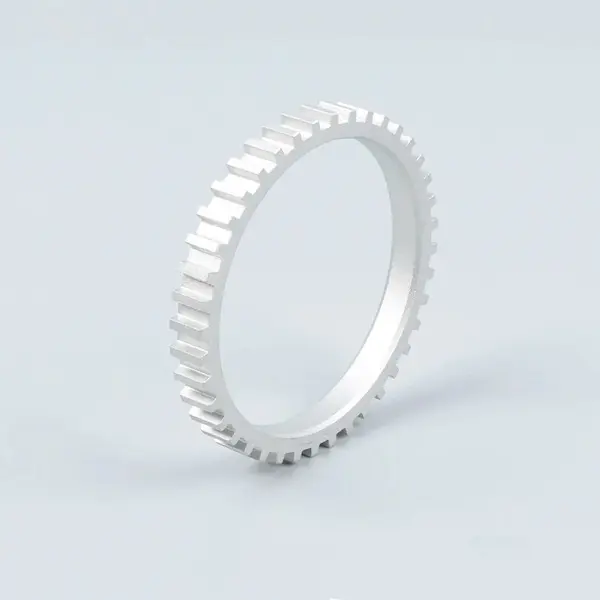
A traditional toothed tone ring rotates alongside the wheel or axle. As each tooth and gap passes a compatible sensor, the sensor detects a changing magnetic field or another measurable variation, depending on its design. The resulting pulses provide information about rotational speed.
The electronic control unit processes the signal frequency to estimate how quickly the wheel is turning. A higher pulse frequency generally corresponds to faster rotation, provided the ring’s tooth count and sensing arrangement are known. The control unit can compare signals from different wheels and identify unusual changes.
Some modern systems use magnetic encoder rings rather than conventional metal teeth. These components contain alternating magnetic poles that a compatible sensor detects. The underlying principle is similar in that a repeating pattern creates a signal, but the construction and sensor requirements differ.
Supporting anti-lock braking operation
When a driver applies the brakes firmly, wheel speed can decrease rapidly. If a wheel approaches lockup, the ABS control system can adjust hydraulic pressure to help it continue rotating. Maintaining controlled wheel rotation can support steering ability during hard braking, although actual stopping performance depends on road surface, tires, vehicle condition, and other factors.
The tone ring contributes by enabling consistent wheel-speed measurement. If its signal becomes irregular or disappears, the control unit may not receive reliable information from that wheel. Depending on the vehicle, this can trigger a warning indicator, store a diagnostic fault, or disable certain electronic functions.
A tone ring is therefore part of a wider system. It should not be evaluated separately from the sensor, wiring, control unit, hub, and installation geometry.
Why dimensions and positioning matter
The ring’s diameter, tooth count, tooth spacing, thickness, and mounting profile must match the intended assembly. The spacing between the ring and sensor is also important. A sensor positioned too far away may receive a weak signal, while physical contact can damage either component.
Concentricity matters because the ring should rotate evenly relative to the sensor. Excessive runout can cause the air gap to vary as the wheel turns, potentially creating inconsistent signal strength. A secure mounting arrangement helps prevent movement under vibration and repeated mechanical loading.
Replacement components should be selected using reliable vehicle or assembly identification. Similar-looking rings may have different tooth counts, dimensions, or sensing characteristics.
Material and environmental resistance
Wheel-end components face moisture, road salt, dirt, vibration, temperature changes, and mechanical exposure. A tone ring must maintain its geometry and sensing characteristics under the conditions for which it was designed.
Conventional toothed rings may use suitable ferromagnetic metals, with material and surface protection selected according to the application. Magnetic encoder designs require a different specification that accounts for the magnetic pattern and its protection from damage. A coating or cleaning method that is suitable for one design may be inappropriate for another.
Manufacturing for dependable detection
Manufacturing methods vary with the component design and production volume. Stamping, forming, machining, and other processes may be used to create the required profile. Regardless of the method, manufacturers must control tooth spacing, concentricity, thickness, mounting dimensions, and material characteristics.
Inspection can include dimensional measurement, profile checks, surface evaluation, and material verification. Functional testing with the intended sensor is especially useful because a component may appear correct but still produce an unacceptable signal.
For magnetic encoder rings, quality checks should also verify the magnetic pattern. Appropriate test equipment is needed to assess the consistency and orientation of the encoded poles.
Diagnosing and preventing problems
A wheel-speed fault does not automatically mean the tone ring is defective. Technicians should inspect the sensor, wiring, connectors, mounting, air gap, and surrounding components. Corrosion, debris, bearing play, damaged teeth, or incorrect installation can all affect signal quality.
Vehicle-specific diagnostic procedures should be followed before replacing parts. After installation, the system may require fault-code checks or a controlled road test in accordance with manufacturer instructions.
Consistent signals start with correct components
Reliable wheel-speed detection depends on a compatible sensor and target working together under stable mechanical conditions. Correct dimensions, suitable materials, precise positioning, and functional verification all contribute to consistent signal generation. By treating the tone ring as part of the complete sensing system, manufacturers and service professionals can better support dependable ABS operation.